Showing posts with label peak oil. Show all posts

Wednesday, February 23, 2011

Alert: crude touches $100 per barrel; Brent at $110. UPDATED

Rumors of protests in Saudi Arabia, Libya production cut in half, and trouble in Algeria have caused the oil market to go parabolic. If Iran or Saudi Arabia join the revolutionary party taking place in the other dozen or so countries that are currently in revolt, say goodbye to the false recovery the US has been enjoying.

Algeria oil production:
2008 2,173,000
2009 2,173,000
2010 2,125,000

Iran oil production:
2008 3,800,000
2009 4,000,000

Saudi Arabia production:
2009 7,300,000 (exports)

Libya oil production
2009 1,600,000

Production problems in Libya alone have caused crude to spike to $99.50. Just imagine when the unrest spreads to the big producers. If you are not well acquainted with the theory of peak oil, now is the time to learn about one of the most important issues of our generation.

Peak oil charts:


Oil discoveries:


An intro to peak oil from Wikipedia:

Peak oil is the point in time when the maximum rate of global petroleum extraction is reached, after which the rate of production enters terminal decline. This concept is based on the observed production rates of individual oil wells, and the combined production rate of a field of related oil wells. The aggregate production rate from an oil field over time usually grows exponentially until the rate peaks and then declines—sometimes rapidly—until the field is depleted. This concept is derived from the Hubbert curve, and has been shown to be applicable to the sum of a nation’s domestic production rate, and is similarly applied to the global rate of petroleum production. Peak oil is often confused with oil depletion; peak oil is the point of maximum production while depletion refers to a period of falling reserves and supply.

M. King Hubbert created and first used the models behind peak oil in 1956 to accurately predict that United States oil production would peak between 1965 and 1971 His logistic model, now called Hubbert peak theory, and its variants have described with reasonable accuracy the peak and decline of production from oil wells, fields, regions, and countries, and has also proved useful in other limited-resource production-domains. According to the Hubbert model, the production rate of a limited resource will follow a roughly symmetrical logistic distribution curve (sometimes incorrectly compared to a bell-shaped curve) based on the limits of exploitability and market pressures.

Some observers, such as petroleum industry experts Kenneth S. Deffeyes and Matthew Simmons, believe the high dependence of most modern industrial transport, agricultural, and industrial systems on the relative low cost and high availability of oil will cause the post-peak production decline and possible severe increases in the price of oil to have negative implications for the global economy. Predictions vary greatly as to what exactly these negative effects would be. If political and economic changes only occur in reaction to high prices and shortages rather than in reaction to the threat of a peak, then the degree of economic damage to importing countries will largely depend on how rapidly oil imports decline post-peak.

Optimistic estimations of peak production forecast the global decline will begin by 2020 or later, and assume major investments in alternatives will occur before a crisis, without requiring major changes in the lifestyle of heavily oil-consuming nations. These models show the price of oil at first escalating and then retreating as other types of fuel and energy sources are used.[4] Pessimistic predictions of future oil production operate on the thesis that either the peak has already occurred, that oil production is on the cusp of the peak, or that it will occur shortly. The International Energy Agency (IEA) says production of conventional crude oil peaked in 2006. As proactive mitigation may no longer be an option, a global depression is predicted, perhaps even initiating a chain reaction of the various feedback mechanisms in the global market that might stimulate a collapse of global industrial civilization, potentially leading to large population declines within a short period.


It is extremely important that you learn about peak oil as it will have profound implications for our world and our lives.

UPDATE: due to the debate that this post has stirred I have posted 3 videos from Dr. Martenson's website, Chrismartenson.com. Dr. Martenson is the author of the crash course which discusses the theory of peak oil in great detail. I recommend that the crash course is watched in its entirety. Here are the clips:


Subprime

Sunday, July 11, 2010

Lloyd's adds its voice to dire 'peak oil' warnings

One of the City's most respected institutions has warned of "catastrophic consequences" for businesses that fail to prepare for a world of increasing oil scarcity and a lower carbon economy.

The Lloyd's insurance market and the highly regarded Institute of Strategic Studies (ISS, known as Chatham House) says Britain needs to be ready for "peak oil" and disrupted energy supplies at a time of soaring fuel demand in China and India, constraints on production caused by the BP oil spill and political moves to cut CO2 to halt global warming.

"Companies which are able to take advantage of this new energy reality will increase both their resilience and competitiveness. Failure to do so could lead to expensive and potentially catastrophic consequences," says the Lloyd's and ISS report "Sustainable energy security: strategic risks and opportunities for business".


http://www.guardian.co.uk/business/2010/jul/11/peak-oil-energy-disruption

Subprime: more and more multinational corporations are catching on to the peak oil problem. Unlike global warming where there is heated public debate and discussion, peak oil has remained on the sidelines. It is rarely ever mentioned in American media. Also, in contrast to public awareness regarding global warming, many of the smartest people that I know have never heard of peak oil.

I've noticed a recent uptick in coverage and awareness of peak oil. Lloyd's getting on board is huge because as a insurance company they price in future energy inputs and costs that result thereto.

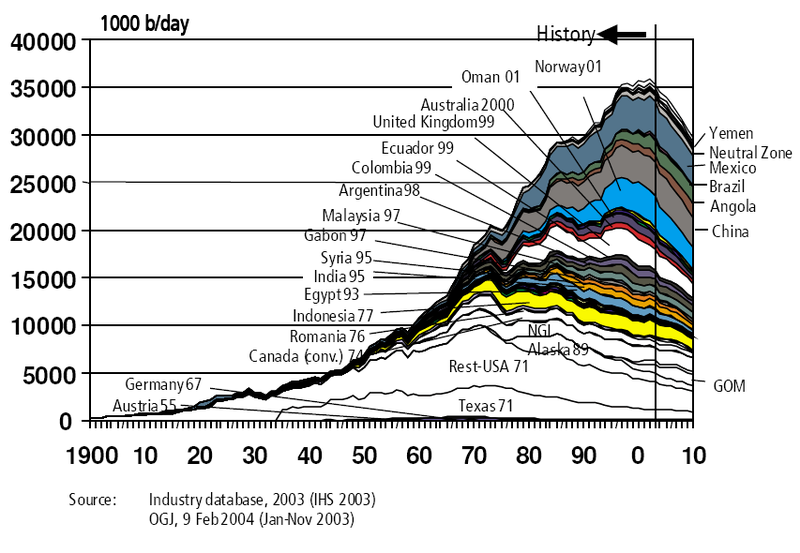
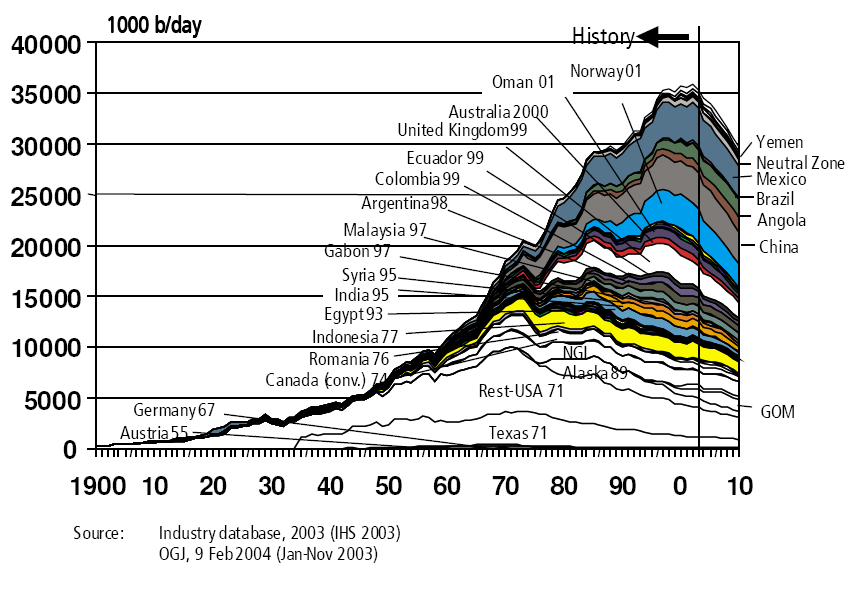
This chart (please click on the photo) shows the production levels of oil producing nations and what year they peaked. Once a nation has hit a peak in production, the decline follows thereafter with decline rates up to 10% per annum. The US has been in decline since 1971.


Forecasts concering the impact of peak oil range from problematic to catastrophic. I am still waiting before I make a personal forecast of my own. Nevertheless, declining oil production at a time when China and India with 2.5 billion people are economically growing at 10% equates to a supply crunch the likes of which the world has never seen. The late 70's oil crunches were politically caused whereas the 2008 oil crunch ($147 crude) and future oil crunches will be geologically caused. Hence, the reason why the US military is presently occupying a nation with over 200 billion barrels of light, sweet, recoverable crude. At the moment Iraq is producing a paltry 2 million barrels per day but the hopes are that the nation will be able to increase its output to over 8 million barrels per day. Its been 7 years since the invasion and still production levels are sub 2002 levels.

Here is the latest chart from the IEA and it doesn't look good.


In addition, when you add in the fiscal and monetary woes the world is currently experiencing, peak oil seems like the final nail in the coffin. The US is highly exposed to higher oil prices as America consumes 22 million barrels per day out of the global production of 86 million bpd.

States and cities are broke, the banks are busted and are only surviving as going concerns due to false accounting rules. The federal government is blowing through 1.5 trillion dollar deficits for the second year in a row. Interest rates are held at 0 by the US central bank in the hope that somehow, someway, the economy will take off again. When we have massive institutions like Lloyd's pricing in the effects of peak oil, our true woes are only beginning.

I hate to be so fucking pessimistic, but now is the time to look at REAL FACTS, and not just smoke and mirrors.

Monday, June 21, 2010

What happens when energy resources deplete?

From the Oil Drum:

What happens when energy resources, such as oil, deplete? Many people believe that oil prices will just go up--but I don't see that to be the case. A more likely result is a future dominated by recession and debt defaults--similar to what we have been seeing recently, but trending over time to be worse. In the midst of this recession, the view may be that there is plenty of oil, if only the price were higher.

Views of Oil Prices
One view is that energy prices will rise, substitutes will be found, and prices will come back down again, perhaps settling at a somewhat higher equilibrium reflecting the cost of producing the substitute energy source. The economy will continue to function pretty much as before. The catch is that we aren't finding reasonably-priced, scalable substitutes, so this isn't happening. Oil prices are down, but not because of substitutes.

Another view, popular among those concerned about peak-oil, is that oil and energy prices will just keep rising. If scalable substitutes aren't found, some expect that oil prices will rise from their current price of $75 barrel, to $100 barrel, to $200 barrel, to $300 barrel, and eventually to $1,000 barrel or more.

The problem with this view is that it doesn't take into account the amount of money people actually have available to spend. Just because oil or energy prices rise doesn't mean that people will get additional income to cover these higher expenditures. In real life, prices can't keep going up.

I expect that what really will happen is oil prices may bounce up, but they will soon come back down again, because of recessionary impacts and credit crunches caused by high oil prices. Most of the time, oil prices will end up in the uncomfortable middle--too high for the economy to buzz along, but too low to encourage much new oil production, or much new renewable production. The result is likely to be continuing recession, getting worse over time, because of what will be generally viewed as inadequate demand for oil.

Rest of the article:
http://www.theoildrum.com/node/6624
Real Time Analytics